How to Choose a Video Editor for Freelancers is designed as a practical operations playbook, not just a high-level overview.
Match project mix, turnaround demands, and collaboration style to the right tool. This guide translates that goal into concrete steps your team can apply this week.
Use the framework below to improve video editing output quality, reduce unnecessary revisions, and scale production without losing consistency.
Context and Problem Statement
Most teams do not fail because of weak creativity. They fail because production systems are unclear, responsibilities are blurry, and quality checks happen too late.
When process is inconsistent, contributors spend more time redoing work than shipping finished assets. A documented workflow fixes this by making decisions repeatable.
Treat this topic as a system design problem: define standards, enforce handoffs, and measure outcomes over time.
Implementation Framework (Start to Finish)
- Audit your current workflow and map every handoff point.
- Define a clear quality bar for each destination channel.
- Create template sets, naming rules, and export profiles.
- Add lightweight review gates with explicit pass/fail criteria.
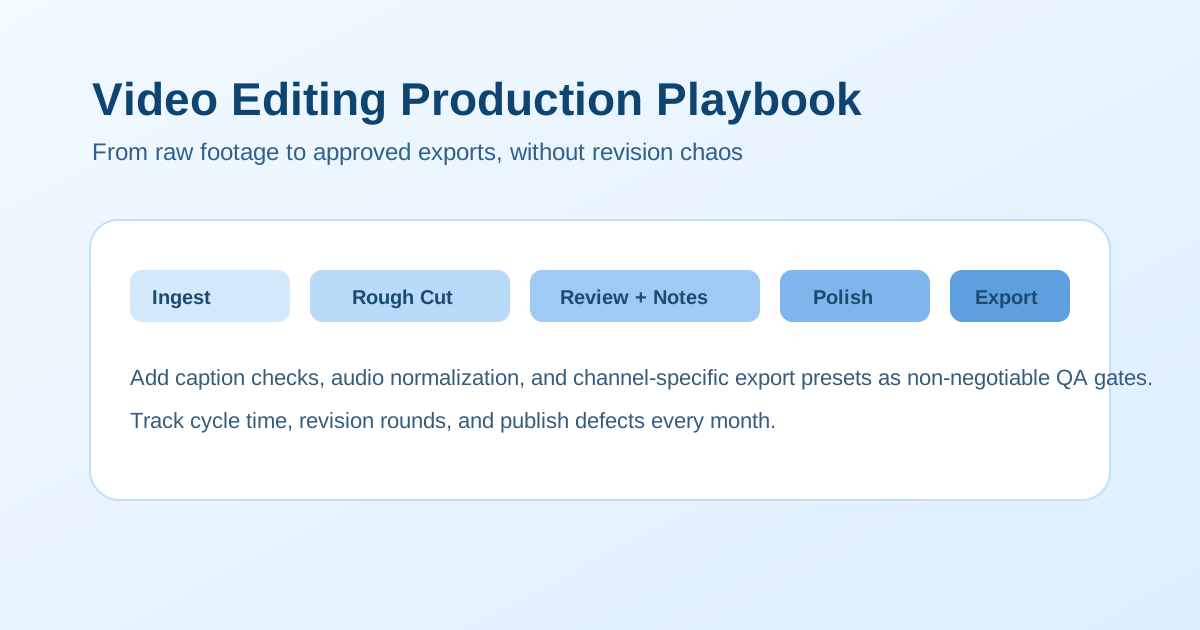
- Measure cycle time, revision count, and publish defects monthly.
- Update your SOP based on recurring bottlenecks.
Operating Model for Small and Mid-Sized Teams
| Role | Primary responsibility | Output expected |
|---|---|---|
| Creator | Prepare first draft using approved templates | Publish-ready draft with notes |
| Reviewer | Check quality, consistency, and policy alignment | Clear approve/revise decision |
| Approver | Confirm final fit for channel and campaign goal | Final sign-off with deadline |
| Ops owner | Maintain SOP, templates, and metrics | Monthly process improvement plan |
Detailed Quality Rubric
| Quality signal | What good looks like | How to verify |
|---|---|---|
| Clarity | The audience understands purpose within 5 seconds | Run a quick comprehension test with one teammate |
| Consistency | Typography, spacing, and tone match brand rules | Check against a template QA checklist before publish |
| Compliance | No PII, confidential data, or licensing issues remain | Use a documented privacy/legal review gate |
| Performance | Exports are optimized for channel limits and speed | Validate dimensions, format, and file weight pre-publish |
Realistic 30-Day Rollout Plan
- Week 1: Audit existing assets and isolate top recurring defects.
- Week 2: Build baseline templates and document review standards.
- Week 3: Pilot workflow with one campaign and collect metrics.
- Week 4: Finalize SOP, train contributors, and lock ownership.
Common Failure Modes and Recovery Moves
- Failure: Teams skip template governance. Recovery: assign one template owner and version policy.
- Failure: Feedback is vague. Recovery: require comments tied to explicit quality rules.
- Failure: Export defects repeat. Recovery: add pre-publish checklist and channel-specific presets.
- Failure: Process docs go stale. Recovery: schedule monthly review cadence with metrics.
Measurement Dashboard (KPIs That Matter)
| KPI | Target direction | Why it matters |
|---|---|---|
| Cycle time | Down | Indicates faster production and fewer bottlenecks |
| Revision rounds | Down | Shows improved brief quality and review clarity |
| Publish defects | Down | Reflects stronger QA and export governance |
| On-time delivery | Up | Measures operational reliability under deadlines |
Action Checklist You Can Execute Today
- Choose one active project as your process pilot.
- Create a single source of truth for templates and naming rules.
- Define pass/fail criteria for review comments.
- Introduce a quick pre-publish checklist for every export.
- Set a 30-day review meeting with KPI snapshots.
Closing Guidance
High-quality content systems are built through operational discipline. Keep the workflow simple, measurable, and documented.
When contributors know what good looks like, output quality rises and review time drops. That is the fastest path to scalable, non-thin, useful content.
Video Walkthroughs
Review these walkthrough collections to validate workflows before standardizing your team process.
References and Resources
Frequently Asked Questions
How often should this playbook be updated?
For fast-moving teams, review monthly. For stable teams, quarterly updates are usually enough to keep standards current.
Who should own this workflow?
Assign one content operations owner responsible for templates, approval rules, and KPI reporting.
Can small teams apply this without extra headcount?
Yes. Start lightweight: one template owner, one reviewer checklist, and one monthly metrics review.
What is the first metric to track?
Track end-to-end cycle time first. It quickly reveals whether your process changes are actually reducing friction.